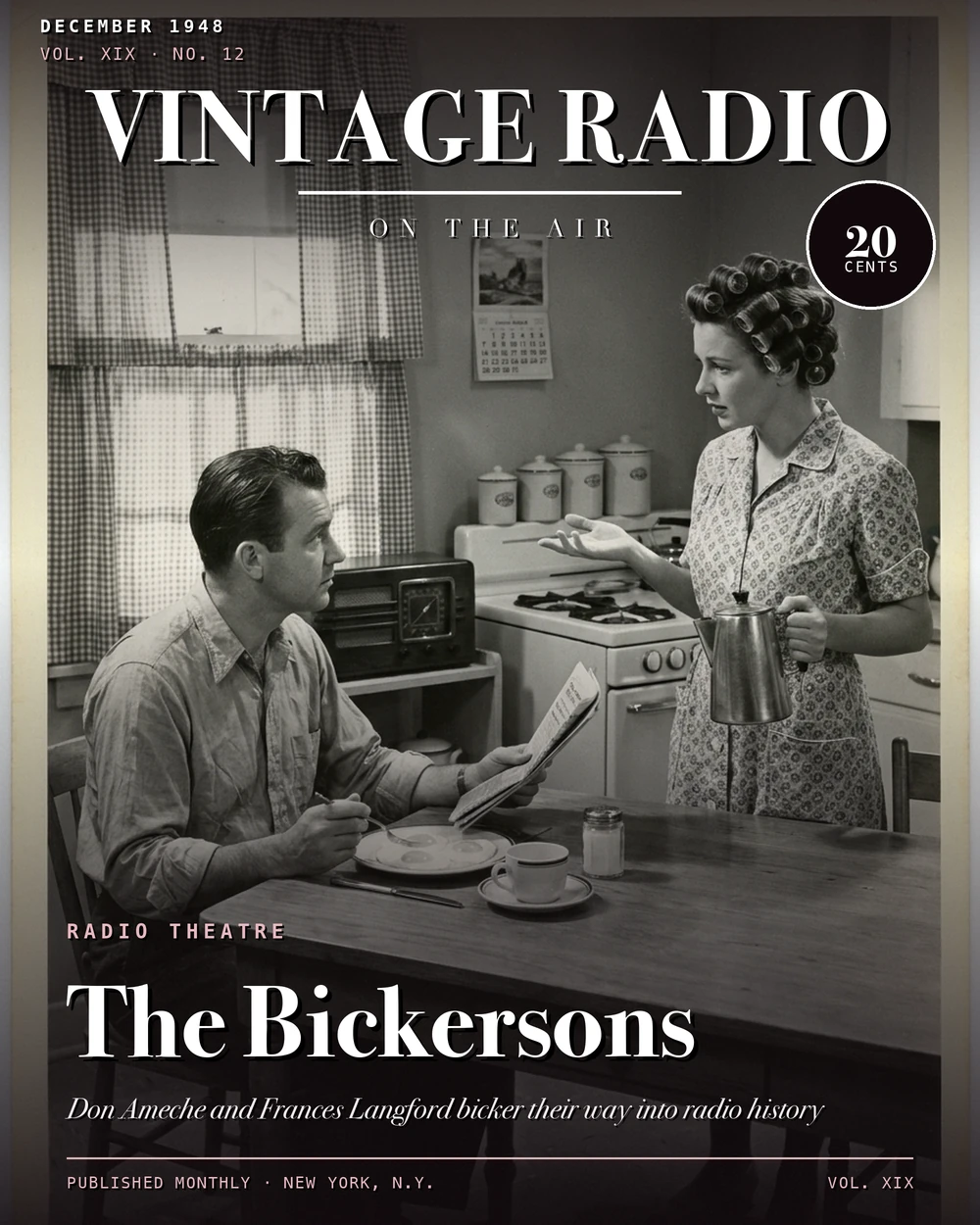
The Bickersons
How It Started
The Bickersons didn't arrive on the air fully formed. When NBC premiered Drene Time — a half-hour comedy-variety program sponsored by Drene Shampoo — on September 8, 1946, the show was unremarkable enough that it passed without much notice. What changed things was a single hire. On December 15, 1946, writer Philip Rapp was brought in to overhaul the program. That same episode introduced Frances Langford and Danny Thomas to the cast, and with them came a recurring sketch subtitled "The Honeymoon Is Over" — featuring a married couple named John and Blanche Bickerson, who spent their nights doing exactly what the subtitle promised.
The premise was deceptively simple. John Bickerson snored. Blanche couldn't sleep. So she woke him, and the argument was on. The announcer — Marvin Miller, after the December overhaul — would set the scene by describing John as suffering from "Schmoe's Disease," the show's comic name for his chronic snoring. From there, the writing did the rest. Rapp had spent years writing for Eddie Cantor and vaudeville before moving to radio, and he understood the difference between jokes and characters. John and Blanche didn't trade zingers — they went after each other with the weary, specific cruelty of two people who know exactly where to press. The recurring comic territory covered John's preoccupation with bourbon, Blanche's cooking, her relationship with money, and above all that snoring that set everything in motion.
Don Ameche played John, Frances Langford played Blanche, and neither of them had done this kind of combative comedy before. Ameche, born Dominic Felix Amici in Kenosha, Wisconsin, was known primarily as a leading man; Langford had made her name as the "GI Nightingale," the singer who'd done frontline USO tours with Bob Hope during the war. Casting them as a bickering married couple was a gamble that paid off. Music for the NBC run came from Carmen Dragon and His Orchestra, with Carlton Alsop producing and Tobe Reed announcing before Miller took over.
The Cast That Made It Work
The chemistry between Ameche and Langford was the engine of the whole enterprise. Langford had originally trained as an opera singer — a tonsillectomy early in her life had changed her soprano into a rich contralto, which made her career in popular music — and she brought a quality to Blanche that kept the character from being simply shrill. Blanche had her own logic. She had her own grievances. The audience wasn't meant to side with John, or entirely with Blanche — they were meant to recognize something, and apparently they did.
Danny Thomas rounded out the NBC cast as Amos, Blanche's brother, a recurring figure who always addressed John as "Jacko." Thomas served as a useful third point in the sketches, but the center was always the married couple. Rapp built his material around a set of fixed comic elements that could be recombined in different configurations — the snoring, the bourbon, the cooking, the money disputes — and occasionally allowed something more unexpected through. A Christmas sketch structured around O. Henry's "The Gift of the Magi" had Blanche trading a fur coat to buy John a portable bar, and John trading his stock to buy Blanche a matching fur muffler. The writers knew the comedy landed harder when there was something real underneath it.
When the show moved to CBS on September 24, 1947, now titled The Old Gold Show and sponsored by Old Gold Cigarettes, comic Frank Morgan joined the cast, and the subtitle shifted to "The Bickersons" or "Mr. and Mrs. Bickerson." The CBS run aired Wednesdays and then Fridays at 9, and the show settled into what became its most recognized form. The New York Herald Tribune critic John Crosby, in a column published May 25, 1948, coined the phrase "The Bickering Bickersons" — one of the earliest and most detailed contemporary reviews the show received.
Between the CBS run and the 1951 revival, Ameche and Langford appeared in Bickersons sketches on NBC's The Charlie McCarthy Show from October to December 1948, though Marsha Hunt replaced Langford as the female lead in those appearances.
Phil Rapp and the Writing
Philip Rapp was born March 26, 1907, in England, to Austrian-born parents, and emigrated to the United States as a teenager. He started in vaudeville as a novelty dancer, moved into gag writing for comedians, and by the 1930s was writing for Eddie Cantor on radio. Before The Bickersons, he had already created the Baby Snooks character for Fanny Brice — developing it for Brice's performances on Ziegfeld Follies of the Air on CBS in 1936, a series he wrote and directed. He also wrote screenplays for six Danny Kaye films, including Wonder Man and The Inspector General, and later directed and produced the television series Topper and I Married Joan.
The Bickersons sketches were what Rapp was built for. One critic described the show's approach as "character comedy with teeth in it" — a deliberate contrast with the typically cheerful domestic portrayals common in 1940s radio comedy. The fighting wasn't incidental to the comedy; it was the whole point, and Rapp calibrated it carefully. The characters had consistent internal lives. John was not simply a buffoon and Blanche was not simply a nag — they were a specific couple with specific history, and the best sketches drew on that specificity.
Rapp served as creator, writer, and producer throughout the show's run, and his personal papers — scripts, letters, photos — are now held in the Phil Rapp Collection at the American Radio Archives at the University of California Santa Barbara, measuring 27 linear feet across 35 boxes. Ben Ohmart's book The Bickersons: A Biography of Radio's Wittiest Program (BearManor Media), compiled from those papers, is the definitive treatment of the show's history; Frances Langford wrote the foreword in 2004, shortly before her death. BearManor also published The Bickersons Scripts (2002), edited from the Rapp papers, which includes 13 complete scripts from the various runs — among them a Halloween episode written for a proposed animated series that was never produced.
The 1951 Revival and the Television Years
The series titled simply The Bickersons — the first time that name had been used as the official program title — aired on CBS from June 5 to August 28, 1951, a Tuesday-night summer replacement series sponsored by Philip Morris. It ran exactly 13 episodes. The significant change was in the casting: Lew Parker replaced Ameche as John, playing opposite Langford. The substitution did not go unnoticed. Radio Life described the series as "appalling," and it generated little excitement in its brief run.
The television history of the Bickersons was complicated from the start. Parker and Langford had already played the couple on the DuMont Network variety series Star Time, which ran from September 5, 1950, to February 27, 1951. That show originated from the Ambassador Playhouse with Food Stores Corporation as sponsor; Rapp was among the writers. The Billboard trade critic Joe Czida reviewed the Star Time premiere and called the Bickersons segment "so far superior to the rest of the package," crediting Rapp's writing as "basically responsible for the bit's wow qualities." Five half-hour segments of Star Time survive in the Library of Congress J. Fred and Leslie W. MacDonald Collection, including the premiere and several episodes featuring the Bickerson skits alongside the Benny Goodman Sextet.
The consensus was that the show worked less well on television. Critics noted that the persistent bedroom setting was "less than ideal for the visual medium," and Langford simply didn't have the same anti-chemistry with Parker that she'd had with Ameche. A syndicated television series, It's the Bickersons, followed in 1951 with Parker again as John but with Virginia Grey replacing Langford as Blanche. That version lasted one season. In the apartment at number 22, the couple had a cat named Nature Boy, and supporting characters included Blanche's sister Clara Gollup and brother-in-law Barney Gollup. After the syndicated series ended, Bickersons sketches continued appearing on variety shows through 1953, with Parker still as John and Betty Kean as Blanche.
Ameche and Langford also co-hosted the ABC daytime variety series The Frances Langford–Don Ameche Show in 1951–1952, which featured a young Jack Lemmon in a recurring newlywed sketch called "The Couple Next Door." And on May 1, 1960, Langford hosted The Frances Langford Special on NBC, reuniting with Ameche to recreate classic Bickersons sketches for a new audience.
What Came After
Ameche and Langford recorded the characters for Columbia Records, releasing The Bickersons (CL-1692) and The Bickersons Fight Back in 1962 — described as a pair of charting albums upon release. A two-record gatefold reissue titled The Bickersons Rematch combined both albums. Rapp produced the recordings and appeared himself as a third actor in one track, "The Bickersons at Sea." Other track titles from the set include "Breakfast with John and Blanche," "Wedding Anniversary," and "Later That Same Evening." The material was newly written for the recordings rather than taken directly from the broadcasts.
The show's longer influence is harder to measure but not subtle. Rapp filed a lawsuit against Jackie Gleason over the resemblance of The Honeymooners to The Bickersons — a case documented in Ben Ohmart's biography from court records. Honeymooners writers Harry Crane and Joe Bigelow specifically cited the radio show as the basis for Gleason's concept, noting that Gleason wanted "a realistic portrayal of life for a poor husband and wife living in Brooklyn" drawn from the popular radio program. The Bickersons' format — combative marriage, working-class setting, no resolution that sticks — became a template for a kind of television comedy that ran for decades. All in the Family is part of the same lineage.
The characters stayed embedded in popular culture in quieter ways too. In the 1970 film MASH, Father Mulcahy wonders aloud whether a suspicious sound from a bugged tent might be "an episode of The Bickersons." The NBC sitcom NewsRadio has a character call a bickering couple "the magnificent Bickersons" — a pun on Orson Welles' The Magnificent Ambersons that assumes the audience knows the reference. The characters can be heard on the radio during driving sequences in the video game L.A. Noire. The stage version, a 1967 play titled Match Please, Darling, was written by Rapp with his son Joel and performed at the Coronet Theater in Los Angeles. For a show that ran in its original form for less than two full seasons on radio, the reach turned out to be considerable.